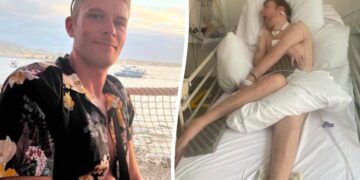


















A dad of five whose pancreatic cancer was diagnosed months after he first went to hospital was left screaming for someone to “chop off” his legs as he lay in agony – before dying in hospital minutes later.
Bharat Gharu, 71, was initially admitted to hospital with abdominal pain and bloating in June 2024.
He was diagnosed with acute pancreatitis, an inflammation of the pancreas, and discharged.
His family says he was promised a follow-up appointment two months later, but never heard back.
When his symptoms worsened, Bharat returned to hospital in November 2024, where doctors discovered a growth.
A biopsy in January 2025 revealed he had stage four pancreatic cancer, which had spread to his lungs, liver and bones.
Doctors told him his options were chemotherapy or palliative care, and he chose to spend his remaining time at home.
But six weeks later, Bharat collapsed in his bathroom in severe pain.
His daughter Careena Gharu, 39, says the family struggled to get emergency help and that her father was left waiting in a hospital corridor while screaming in agony.
He died shortly after being moved into a room.

Careena, a graphic designer and yoga teacher from Redbridge, London, England, said: “If it had been followed up properly the first time, he could have had surgery.
“But it had spread so quickly doctors told us the only option was chemotherapy or palliative care.
“They administered some morphine in the ambulance, but when we got to the hospital he was still in agony. They left us in a corridor. He was screaming ‘somebody help me’.
“My dad was failed at every step, until he died an extremely painful death that could have been avoided.”
Bharat first began experiencing abdominal discomfort in June 2024.
He was admitted to hospital, diagnosed with acute pancreatitis and discharged.
His family says doctors promised a follow-up appointment within two months, but no appointment came.
In November 2024, Bharat returned to hospital with the same symptoms.
Doctors discovered a growth and told him it would be investigated.
He underwent a biopsy in January 2025 and was diagnosed with stage four pancreatic cancer that had already spread to his lungs, liver and bones.

Careena, who also lives in Redbridge, told Talk to the Press: “Everybody was devastated including him, it was such a shock.
“We were distraught that it had gone that far without us even knowing it could have been cancer.
“He was told he had two options: chemotherapy or palliative care. He chose palliative care. He wanted to be comfortable at home.
“He knew nothing could be done, and he wanted to live out his last days pain free.”
She added: “The palliative care team gave my mum a number to call if the pain ever got to bad or in an emergency, and they said they’d come out and give him injections that get rid of the pain and calm him, to make his end of life easier.”
But on March 16, 2025, Bharat collapsed in the bathroom at home.
His wife called the palliative care team, but Careena claims they refused to send anyone to help.
Careena said: “He couldn’t stand, he was in absolute agony, and was passing blood through his stool. My mum immediately did what she was told and called the palliative care team.
“But they were so rude and dismissive. They said it was probably just hemorrhoids, so they weren’t going to send anyone out.
“My younger brother got on the phone and begged them. He pleaded with them to send someone out, but they just told us to call 111.
“At that point my dad was screaming saying ‘someone help me,’ ‘someone chop off my legs,’ because the pain was so severe.
“We called 999, and the first paramedic who arrived just shouted at him to calm down, it was awful.
“Then two more came and managed to lift him from the bathroom to the bedroom.”

Careena says paramedics initially refused to administer pain medication because they needed a medication chart from the palliative care team.
She claims her father continued screaming in pain while the family waited for help.
Careena said: “He was still screaming the whole time and they refused any pain relief.
“They wouldn’t even take him to hospital. But no one from the palliative care team were coming. We were just waiting for someone to help him but no one would.
“Eventually, because the palliative care team were taking so long, they decided to take him to hospital.
“I followed the ambulance. There were no blue lights, no sense of urgency, nothing.”
Her brother Ravi Gharu, 36, traveled in the ambulance with their father.
He said: “My dad was slamming his hand against the side of the ambulance, screaming in pain. He was screaming “Come on, someone do something.”
Careena claims that when they arrived at the hospital, Bharat was left waiting in a corridor.
She and Ravi desperately tried to get medical staff to help him.
Careena said: “Me and my brother were running around the ward shouting for the doctors to help but they said he had to be ‘logged in’ by the paramedic before he could be seen.
“At one point he pointed at his chest and said ‘I can’t breathe.’ Then a paramedic casually strolled over, looked at him and said: ‘no, I can see him breathing.'”
She says Bharat remained in the corridor for at least 20 minutes before being moved into a room.
A paramedic then checked his blood pressure.

Careena said: “It was 44 over 29. The paramedic thought the reading was wrong, but it was because he was dying.
“Then my dad looked at me and my brother, said he couldn’t breathe, and died.
“Suddenly the room filled with nurses and doctors as they tried to resuscitate him, despite no one helping him before.
“I was just chanting ‘come on dad, don’t leave us, you can come back’ hoping he could hear me, but my brother was just in shock.
“I just can’t believe his last hours were that awful. There were so many mistakes made.”
Careena formally complained about the care her father received from the ambulance service and palliative care team.
Both services investigated the incident and produced reports, but Careena says she was disappointed with their responses.
She believes the ambulance service’s report contained contradictions.
According to the report, the first paramedic who attended Bharat “was immediately concerned about the blood on his legs and the possibility of a catastrophic hemorrhage or serious injury, both of which can be life threatening and require urgent management.”
But the report also stated that the ambulance did not use emergency lights because “the catastrophic internal bleed occurred after arrival at the hospital.”
Careena disputes that explanation.
She said: “That’s just not correct. There was blood on his legs. They knew what had happened.
“It just seemed like the palliative care team were blaming the paramedics and the paramedics were blaming the palliative care team.”

Dr. Fenella Wrigley, chief medical officer at London Ambulance Service, said: “We offer our sincere condolences to Mr Gharu’s family and are very sorry for the distress they experienced during his final hours.
“We have taken the feedback from the family very seriously and carried out a detailed clinical review involving senior and specialist end-of-life care clinicians.
“We recognise that aspects of the care and communication experienced by Mr Gharu and his family fell short of what they should expect from us, and we apologise sincerely for this.
“The clinicians involved have reflected on the family’s experience and have met with our End-of-Life Care team as part of the learning arising from the complaint. We remain committed to learning from Mr Gharu’s experience and improving the care and support we provide to patients and families.”
A spokesperson for North East London NHS Foundation Trust (NELFT), which was responsible for the palliative care team, said: “We offer our sincere condolences for the loss of Mr Gharu and are sorry for the concerns raised about their experience.
“We have carefully reviewed the care provided and have taken a number of actions as a result, including additional training for staff, improvements to how our community services are explained to patients and families, and the introduction of an on-call triage service, with trained nurses able to attend patients more quickly when urgent care and medication are required at home.
“We remain committed to improving the care and support we provide to patients and their families.”
A spokesperson for Barts Health NHS Trust said: “We offer our heartfelt condolences to Mr Gharu’s family and loved ones and are sorry that they feel his care did not meet the standards they expected.
“Having reviewed the clinical notes, we believe Mr Gharu was treated appropriately given the seriousness of his medical condition.”